Limassol vs. Dubai: Why Global Investors are Choosing the Mediterranean’s Business Hub

Dubai still dominates headlines for scale and speed, but many global investors are now pairing it with Limassol. Cyprus’ coastal business centre offers a strong professional-services culture and a manageable lifestyle. This guide compares the two and explains why Limassol keeps winning shortlist spots in boardrooms worldwide.
Key takeaways
- Limassol is increasingly used as an EU base for owners who want the euro and a smaller, more liveable operating footprint.
- Dubai is still the main hub for doing business in Gulf countries, growing companies quickly, and staying well connected to global travel and trade routes.
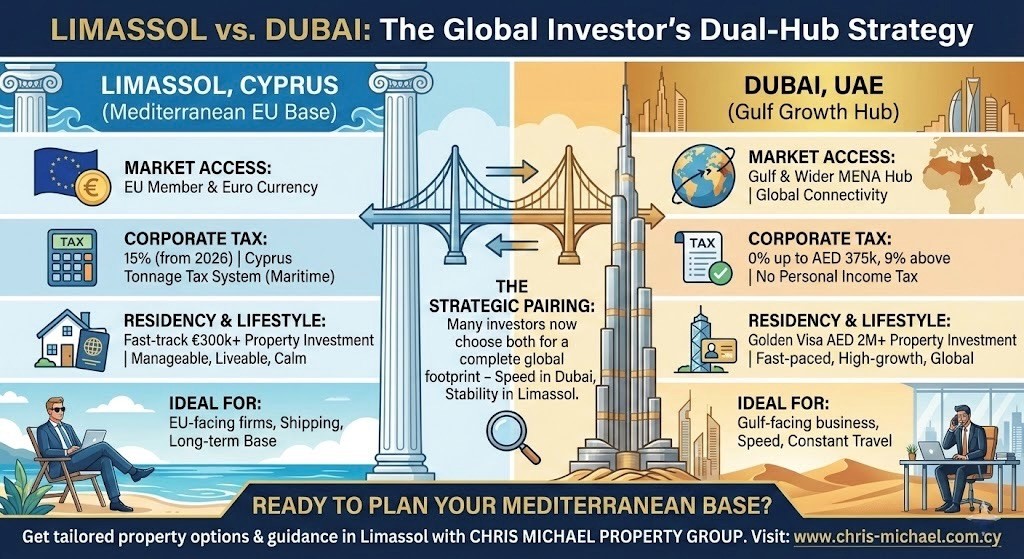
Dubai rewards speed. Many investors now want a second anchor in the European Union: a base for EU-facing work and family life. Limassol now sits on that shortlist.
Limassol vs Dubai at a glance
| Topic | Limassol (Cyprus) | Dubai (United Arab Emirates) |
| Market access | EU member; euro currency | Gulf and wider MENA hub |
| Corporate tax headline | 15% (from 2026) | 0% up to AED 375k; 9% above |
| Personal income tax | Cyprus taxes individuals by residence/income | No income tax on individuals |
| VAT standard rate | 19% | 5% |
1) Market access and counterparty confidence
Cyprus has been an EU member state since 1 May 2004 and adopted the euro on 1 January 2008. For EU-facing businesses, that can make routine matters smoother: euro invoicing, familiar compliance expectations, and counterparties who already know the setting.
Dubai works best when the business is tied to the Gulf: regional procurement, distribution, or constant deal-making across time zones. Many founders keep client development in Dubai even if parts of the operation run elsewhere.
2) Tax and regulation
Cyprus increased corporate income tax to 15% with effect from 1 January 2026. The UAE’s corporate tax system applies 0% on taxable income up to AED 375,000 and 9% above that level. For individuals, the UAE government states it does not levy income tax.
Limassol also benefits from sector depth. The Cyprus Tonnage Tax System is approved by the European Commission as compatible with EU state aid guidelines, supporting a large maritime services cluster.
3) Residency, relocation and the property question
Investors rarely separate business from life for long. When you plan to spend months a year in one place, housing and residency start to matter.
Cyprus publishes a fast-track permanent residency route that can include investing at least €300,000 (plus VAT) in a first-sale house or apartment from a development company, alongside other conditions such as proof of income. This is where Cyprus real estates become a practical discussion about eligibility, contract terms and long-term use.
Dubai also links residency to property investment. The Golden Visa investor route states that the property purchase value should be at least AED 2 million at the time of purchase, with supporting documents required.
4) Costs, operations and staffing
Dubai offers reach and depth, but it can be expensive once a team settles in.
Limassol is smaller and easier to navigate, which many firms find helps keep costs and routines more predictable.
Which location fits which investor?
Limassol tends to suit…
- EU-facing service firms that want the euro and a European base.
- Shipping and maritime services that benefit from the island’s established framework.
- Owners who want a calmer base for long stretches of work.
- Buyers weighing real estate in Cyprus as part of a relocation plan.
Dubai tends to suit…
- Gulf-facing businesses that need frequent travel and constant market access.
- High-growth teams that rely on specialist hiring and dense supplier networks.
- Investors who prefer a no-income-tax personal setting.
Ready to turn your shortlist into a practical plan in Limassol? Speak with Chris Michael Property Group for tailored property options and guidance. Call +357 25313135.
Also Read: The Hidden Costs of Buying Property in Cyprus (And How to Budget for Them)
Frequently Asked Questions:
1) Is Limassol genuinely a business hub, or mainly a lifestyle destination?
Limassol attracts lifestyle buyers, but it also supports international business. Cyprus sits inside the EU and uses the euro, which many EU-facing firms find familiar for contracts and day-to-day transactions. The maritime services ecosystem adds depth beyond tourism.
2) How do corporate tax rules compare between Cyprus and Dubai?
Cyprus increased corporate income tax to 15% from 1 January 2026. The UAE applies 0% on taxable income up to AED 375,000 and 9% above that level. The real comparison depends on structure, substance and where profits arise.
3) Does buying property in Cyprus help with permanent residency?
Cyprus publishes a fast-track permanent residency route that can include a €300,000 (plus VAT) investment in a first-sale home or apartment, plus other conditions such as proof of income. Check the latest criteria and use independent legal advice to review title and contract terms.
4) Can a Dubai property purchase lead to a long-term visa?
Dubai Land Department states that a real estate investor with a property purchase value of at least AED 2 million at the time of purchase can apply for a 10-year renewable residence permit, subject to documentation. Confirm requirements for joint ownership, mortgages and evidence of payments.
5) What should overseas buyers check before purchasing in Cyprus?
Start with purpose: working base, family home, or rental. Then check title, planning status, taxes and ongoing costs through independent professionals. This is also where Cyprus properties should be assessed against practical needs such as flight patterns, schooling and how often you will be on the island. A local surveyor’s report can also flag maintenance costs early.